
Is Your Business Getting Found Online?
Ask ChatGPT, or Google’s AI Mode, to recommend a good local business and you’ll get a short, confident answer. A handful of names. A quick summary of each. Maybe a link or two.
So the question more and more business owners are asking is a simple one: is my business one of those names?
AI search hasn’t replaced Google. But it is changing how people find, compare and choose who to buy from. As an SEO agency in Guildford, we’ve been looking at the latest research to separate what’s genuinely changing from what’s just noise.
AI search is growing, but Google isn’t going anywhere
Let’s start with some perspective. Research from SparkToro found that in 2024 Google handled more than 14 billion searches a day, while ChatGPT handled at most around 37.5 million search-style prompts. That’s roughly 373 Google searches for every one on ChatGPT. Google’s own search volume actually grew by over 20% that year.
So it’s a movement, not a revolution. Not yet.
But here’s the interesting part. Adobe’s 2026 AI and Digital Trends report found that one in four customers already turn to AI platforms first when they’re looking for information, making a purchase decision or asking for recommendations. That puts AI ahead of brand websites and online reviews for that group.
Both things are true at once. Most of the searching still happens on Google. But a growing number of people are going to AI first, often right at the moment they’re deciding who to contact.
People are talking to search, not typing at it
It’s not just where people search that’s shifting. It’s how.
Figures shared by the Chartered Institute of Marketing (CIM) show that an average ChatGPT request is around eight words long, compared with about three for a typical Google search. And the conversations keep going: around 60% of AI chats run past five exchanges, and one in three go beyond eight.
In practice, that looks like this. Instead of typing “roofer Guildford”, someone asks: “Who’s a reliable roofer near Guildford who can fix a flat roof before winter and gives fixed-price quotes?” Then they follow up. “Are they insured?” “What do their reviews say?” “How long does a job like that usually take?”
Your website isn’t answering one keyword any more. It’s helping answer a whole conversation.
The gap between knowing and doing
Adobe’s research, carried out with Oxford Economics across 3,000 business leaders and practitioners, uncovered something that will feel familiar to a lot of business owners.
Nearly a third said their leadership and their day-to-day teams aren’t aligned on AI strategy, and almost half (47%) said alignment was only partial. The biggest cause, named by 61%, was leaders not fully understanding AI. That came ahead of resistance to change and poor communication.
The two groups also wanted different things. Leaders leaned towards revenue growth and customer satisfaction. The people doing the work were far more focused on practical tasks like creating content (36% of practitioners, compared with 14% of executives). And only 54% of organisations said they’re preparing their content to be picked up by AI-powered discovery tools.
In a small business, the leader and the practitioner are often the same person. Or it’s you and one person helping with your marketing. So the gap doesn’t show up as a boardroom disagreement. It shows up as knowing AI search matters, but not being quite sure what to actually do about it on a Monday morning.
The good news is that Adobe also found what helps teams get aligned: clearly communicated goals (72%), planning together (69%) and visible support from the top (59%). That works just as well at small scale. Decide what you want AI search to do for your business, then make a short, practical plan.
How to help your business show up in AI search
Start with strong SEO foundations
AI tools lean on many of the same signals as Google. A website that loads quickly, works well on a phone, is accessible and is easy for search engines to read gives you the best possible starting point.
Write the way your customers talk
Use real questions as headings and answer them directly in the first line or two. FAQ pages, service pages written in plain English and clear explanations are much easier for AI tools to understand and summarise.
Answer the follow-up questions
Think about the second, third and fourth questions someone might ask. Which areas do you cover? Roughly what does a job cost? What accreditations do you hold? How long does it take? The more of these your site answers, the more useful it is to an AI tool building a recommendation.
Show your real experience
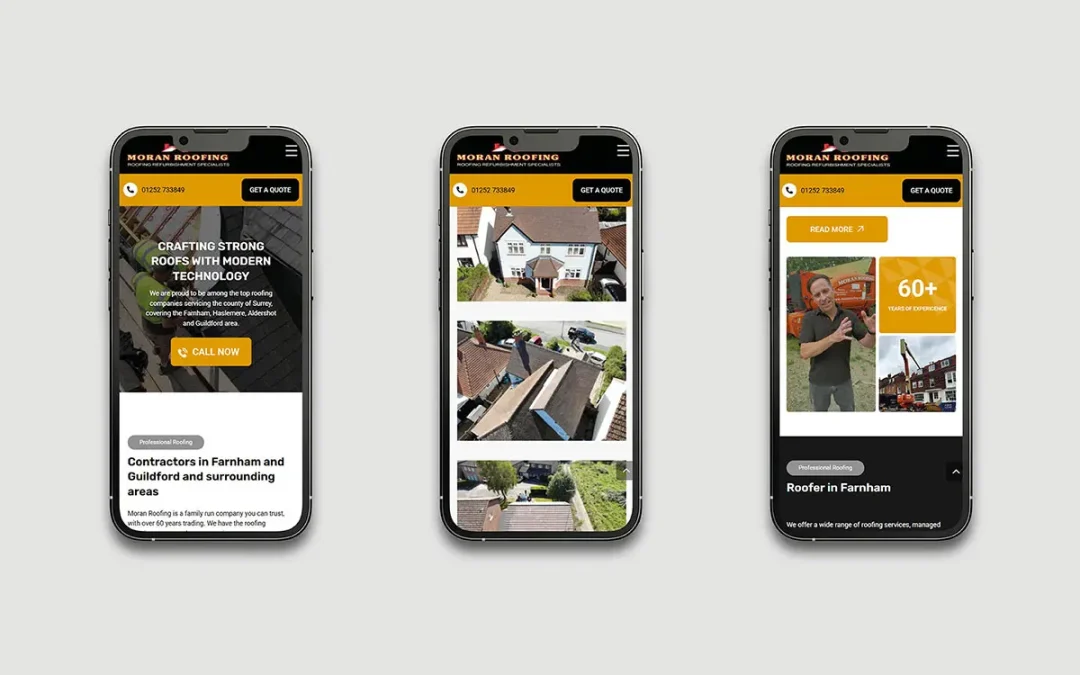
Case studies, project photos and genuine client stories show experience and trust, which matter in both traditional and AI search. Our work page is a good example of letting projects do the talking.
Get talked about in other places
AI tools look beyond your website. Reviews, local directories, chamber of commerce listings, industry blogs, local press and networking all help build the kind of reputation that gets your name mentioned.
Keep expectations realistic on measurement
Tracking AI search is still in its early days. You can spot some AI referral traffic in Google Analytics, but not all of it. A simple habit helps here: ask every new enquiry how they found you.
You don’t have to start from scratch
If you’re not sure where to begin, that’s completely normal. Be Bold takes care of it for you, with done-for-you SEO and websites that help local businesses get found. Get in touch for more information and we’ll share our roadmap to getting found, a clear plan of what we’d do so your business shows up where your customers are searching.
Related Articles:
- From SEO to GEO: how to get your brand cited by generative AI
- Guide to Earning Citations in Google AI Overviews: Playbook for 2026
Quote Sources:
- Adobe, 2026 AI and Digital Trends report, research conducted with Oxford Economics
- SparkToro, New Research: Google Search Grew 20%+ in 2024; receives ~373X more searches than ChatGPT
- Chartered Institute of Marketing (CIM)
Contact us today for help with your website SEO.